

constraint is generative
on OULIPO, submission, and the erotics of the bind

I first encountered the OULIPO movement in college, while getting my BFA in painting. Something about it at the time broke my brain open in the most complete way, and I don’t think I’ve ever been the same since. The philosophy of constraint and its generative possibilities have been an invisible current running beneath almost every creative and magical endeavor since, even when I’ve not been consciously aware of it. Submission to a boundary generates states of consciousness, forms of expression, and kinds of knowledge that remain inaccessible otherwise.
Constraint charts territory that freedom, paradoxically, cannot reach.

the rats who construct the labyrinth from which they plan to escape
In November of 1960, the novelist Raymond Queneau and the mathematician François Le Lionnais founded a small Parisian group they called the Ouvroir de Littérature Potentielle: the Workshop of Potential Literature, or OULIPO.1 The founding meeting was convened as a subcommittee of the Collège de ’Pataphysique, the Parisian institution devoted to the science of “imaginary solutions” and the study of exceptions, and the group was largely made up of novelists, mathematicians, engineers, and poets. “Potential Literature” described their ideal of what writing could become if put under the right kind of pressure. Their intent according to Queneau was: “To propose new ‘structures’ to writers, mathematical in nature, or to invent new artificial or mechanical procedures that will contribute to literary activity: props for inspiration as it were, or rather, in a way, aids for creativity.” Essentially, their idea was to apply sets of rules and mathematical formulae to the process of writing as a means of building conditions under which literature might become something it had never been before.
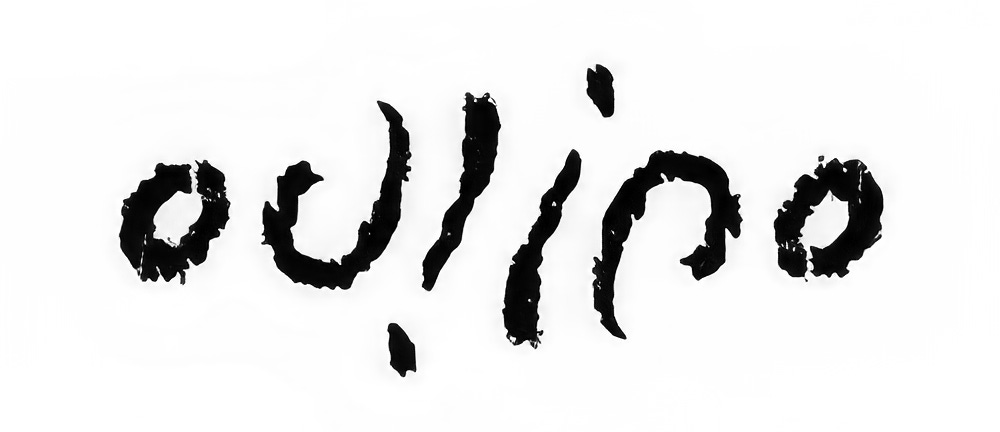
Queneau had spent time as a Surrealist before breaking with André Breton in the 1930s2 For the Surrealists, the ideal creative act was automatic writing: the suspension of conscious control in favor of whatever the unconscious produced. To him, a writer who claimed to be free of all constraint was simply enslaved to unconscious ones. Voluntary writing builds a structure in advance, commits to it absolutely, and discovers that the structure, because it resists the writer, forces invention into territory the unconstrained mind would never reach. He famously referred to Oulipans as “rats who construct the labyrinth from which they plan to escape.”
Despite the mathematical seriousness of the methods, OULIPO was extremely playful in their application. When you commit to a constraint strictly enough, it ultimately leads into territory so absurd the only way out is through comedy, invention, or both. Membership in OULIPO was for life; Queneau noted that the only way to leave was to die, and even then, it was unclear you’d been released.3
It’s at this point I must issue a warning to the reader. Although I have never been an official member of the group, I have been fully captured by this movement for almost 25 years with no escape in sight. Read on at your own risk.
OULIPO divides its activity into two branches. Anoulipism is the retrospective work: identifying writers throughout literary history who operated under self-imposed formal constraints before OULIPO existed to theorize the practice. These writers are called “plagiarists by anticipation,” and all are retroactively drafted into OULIPO’s genealogy.4
Synthoulipism is the prospective work: inventing new constraints and demonstrating their potential. This is where the group’s energy primarily lives, in the generation of new forms that future writers can use. All literature already operates under constraint: the sonnet, the detective novel, and the thriller differ from OULIPO’s more extreme procedures only by degree.
The clinamen is a third key term, borrowed from Lucretius’s atomist physics. In De Rerum Natura, Lucretius describes atoms falling in parallel paths through the void, and posits an unpredictable swerve, the clinamen, that causes them to collide and create the world. Within OULIPO, the clinamen names a conscious deviation from the constraint: a point where the writer deliberately breaks the rule for aesthetic reasons. The clinamen marks the difference between a purely mathematical operation and a work of art. The distinction between a principled and conscious deviation and a failure of nerve or skill is where OULIPO’s literary seriousness lives. There is little power in the breaking of taboos that one never observed in the first place.
the constraints
A lipogram is a text written with the deliberate exclusion of one or more letters of the alphabet, from the Greek leipo, “I leave.” The practice has ancient precedent, but its most famous modern instance is Georges Perec’s La Disparition, which omits the letter E across nearly three hundred pages. This work was also remarkably translated into English as A Void, also without the letter E.
The N+7 method takes any existing text and replaces every noun with the noun appearing seven entries later in a chosen dictionary. Different dictionaries produce different results, but all share a quality that sounds as if it might mean something while continuously sliding away from sense. The method works as a reading device as well as a writing one: running a canonical text through N+7 defamiliarizes it completely and reveals how much of its apparent meaning rests on habitual word combinations.
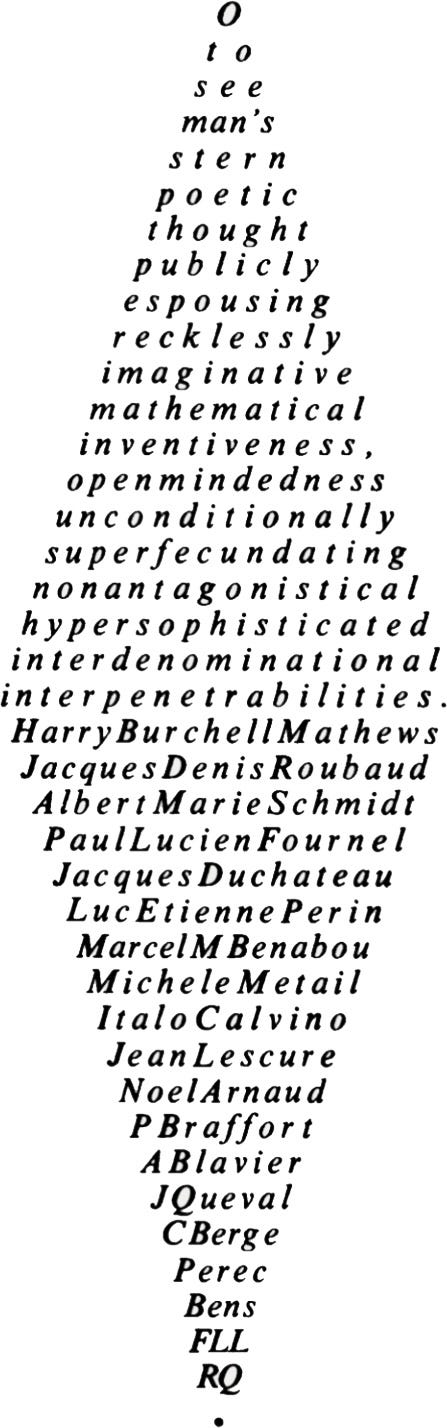
The snowball is a poem whose lines grow by one letter with each verse, one-letter first line, two-letter second, creating a shape on the page that gives the constraint its name.
The prisoner’s constraint permits only letters that contain no ascenders or descenders, only letters that fit between two lines. The palindrome, a word or sentence which is the same written forwards or backwards, was also heavily experimented with, and Perec’s Le Grande Palindrome was 1247 letters long, a unfathomable literary feat.
Cent Mille Milliards de Poèmes (One Hundred Thousand Billion Poems, 1961)5 is the work that most dramatically demonstrates what OULIPO means by potential literature. Ten sonnets are printed on cards, with each of the fourteen lines on a separate strip the reader can cut and recombine. Because all ten sonnets share the same rhyme scheme and end sounds, any line from any sonnet can be combined with any line from any other, producing a grammatically and metrically valid sonnet each time. The total number of possible sonnets is 10¹⁴. Queneau calculated that reading all of them, at one per minute, eight hours a day, would take approximately 190,258,751 years. The work exists primarily as potential: a machine for generating poems that will never all be realized.
This is the philosophical core of OULIPO: constraint generates inexhaustible possibility. The microscopic contains the infinite.
perec and constraint as mourning
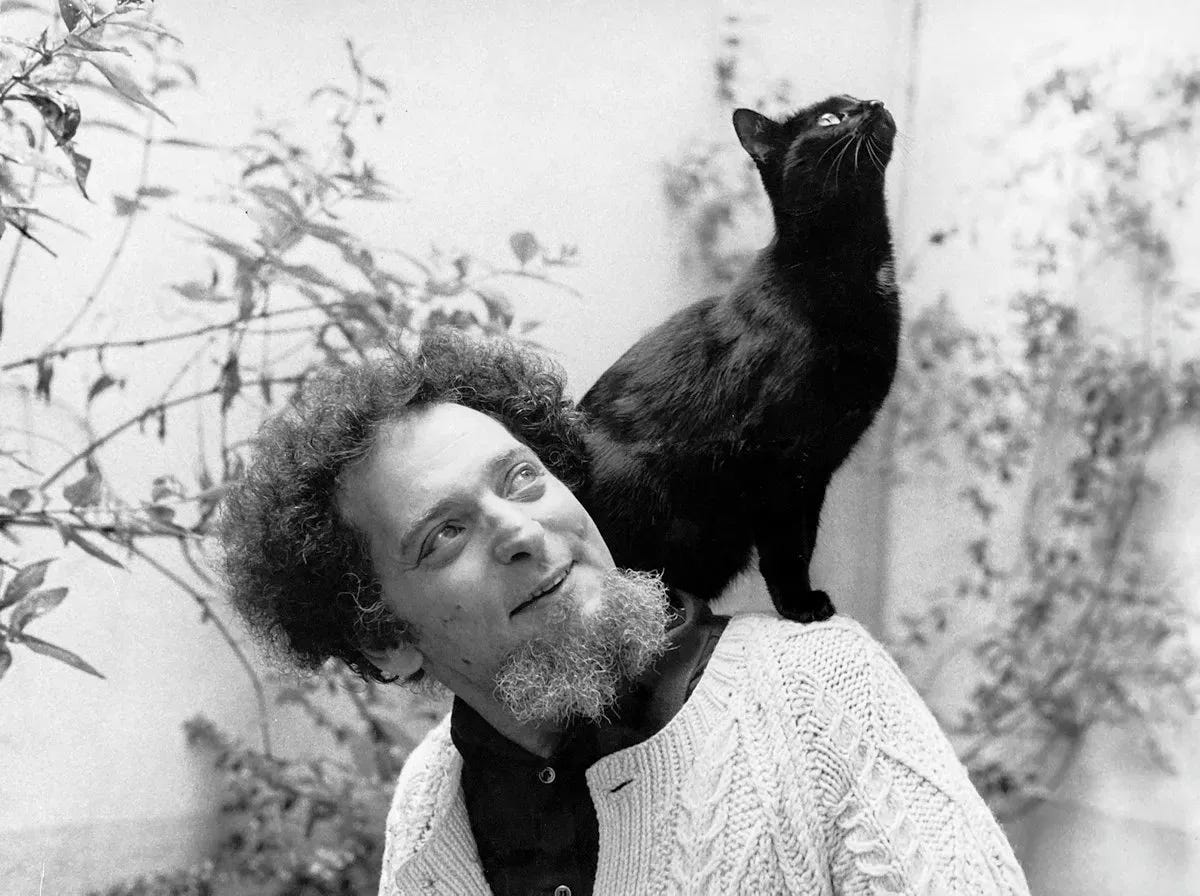
Georges Perec was born in 1936 to Polish Jewish immigrants in Paris. His father, Icek Judko Perec, volunteered for the French army and died in June 1940.6 His mother, Cyrla Perec, was arrested in 1943 and deported to Auschwitz. She never returned. After the war, when Perec sought documentation of her fate, the French bureaucracy certified her not as dead but as “disappeared.” The last official record he received of his mother’s existence was a form called anacte de disparition: a vanishing act, the making of a void.7
La Disparition was published in 1969. At nearly three hundred pages, it contains no instance of the letter E, the most common letter in the French language. The novel follows a group of people searching for their lost friend Anton Vowl. Warren Motte, a scholar of Perec, writes: “The absence of a sign is always the sign of an absence, and the absence of the E in A Void announces a broader discourse on loss, catastrophe, and mourning.”8 As Daniel Levin Becker explains, the formal constraint worked by “foregrounding the technical in order to take pressure off the personal,” which paradoxically allowed the personal “to express itself more or less organically.” Ian Monk adds: “An apparently trivial constraint would thus have given Perec the means of approaching a subject that he had not succeeded in facing directly.”9
This is one of the most moving examples of the generative power of constraint: restriction can open a passage to the material that direct approach cannot. It provides a container for experiencing things without being fully consumed by them.

calvino and the tarot
In Italo Calvino’s 1967 essay “Cybernetics and Ghosts”, he argues that writing is “simply the process of combination among given elements”10 Il castello dei destini incrociati (The Castle of Crossed Destinies) utilizes the tarot as its primary constraint. A group of travelers arrives at a castle, lose the power of speech, and must tell their stories using tarot cards. The narrator attempts to read the sequences laid out by different travelers and decipher their intended meaning. The tarot functions as a combinatorial constraint: a finite deck of 78 cards generates an infinite variety of narrative sequences, and any particular arrangement determines what story can be told from it. As with A Void, the constraint also functions as a plot device within the story itself.
The tarot constraint differs from a purely arbitrary constraint because the tarot carries significations beyond its formal structure. Each card carries layers of symbolic meaning accumulated through centuries of use in divination and esotericism. Calvino acknowledged this tension in the novel’s endnote, writing that he intended the tarot as a means of making language “say something it cannot say, something it doesn’t know, and that no one could ever know.”11
garétta, gender and the turing limit
Anne Garréta was elected to OULIPO in 2000, but her first novel, Sphinx, appeared in 1986, fourteen years earlier.12 Sphinxis a love story written with the constraint that neither of the two main characters, the narrator, and their lover A***, is ever given a gender marker of any kind. In French, a language whose grammar encodes grammatical gender in past-tense verbal agreement and in the coordination of adjectives with their nouns, this is a sustained grammatical feat requiring a complete rethinking of how French sentences can be built13
Garréta’s strategies for maintaining the constraint include sustained first-person narration, obsessive repetition of A***’s half-name as a substitute for pronouns, and physical description through synecdoche: face, body, hand replacing he or she as sentence subjects. A*** exists in the novel entirely through partial descriptions of a body that is never assigned a sex.
The constraint was retroactively formalized as the “Turing constraint” referencing Alan Turing’s imitation game, and added to OULIPO’s official list of procedures after Garréta joined the group. In Garréta’s terms, this is explicitly political as well as formally interesting: the text is “a trap” that exposes the reader’s assumptions about gender, assumptions they bring to the novel and cannot help projecting onto its deliberately blank pronouns.14 Sphinx demonstrates that constraint can operate at the level of social meaning rather than purely at the level of phonological or lexical form .
140 characters

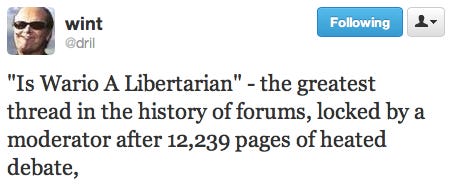
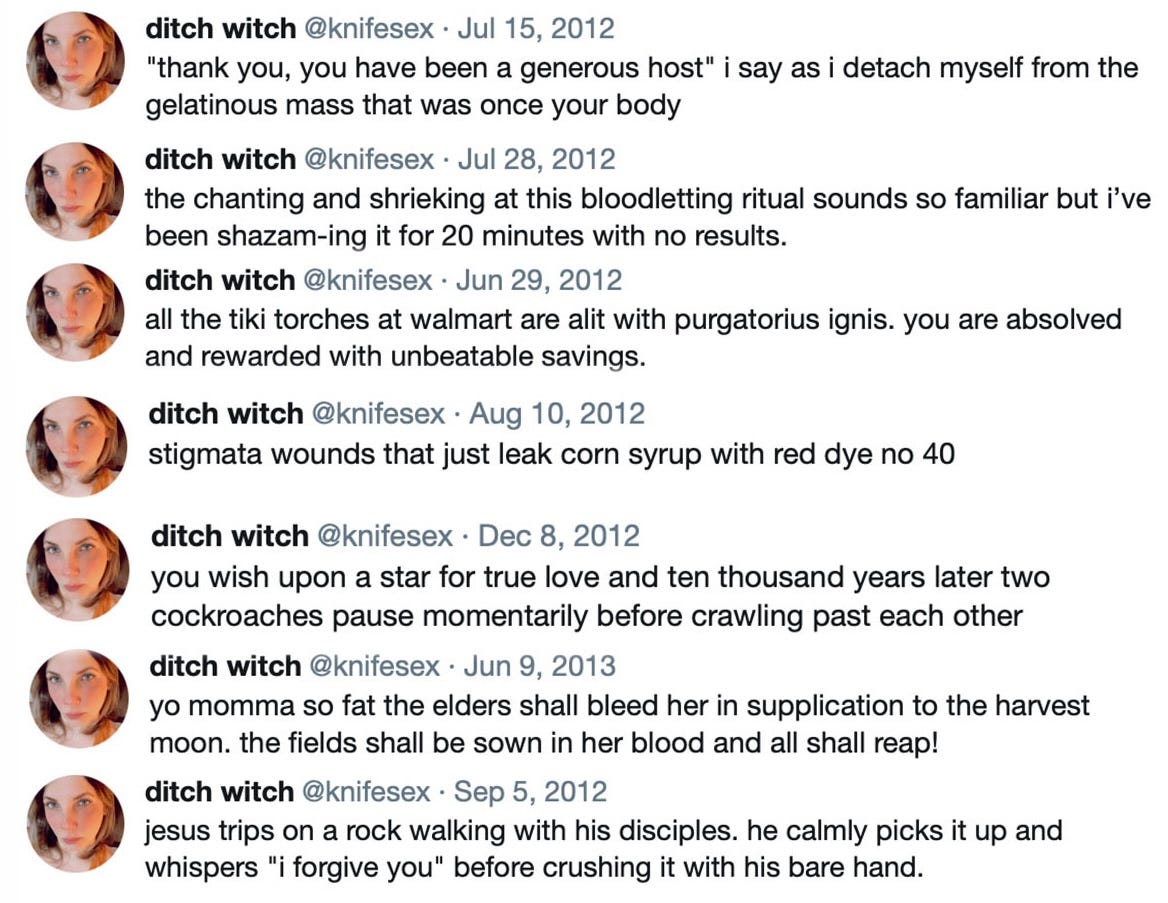
At the risk of embarrassing myself, I want to draw attention to a particular internet phenomenon that was undoubtedly Oulipan in nature: Weird Twitter. Weird Twitter was a very loose movement of writers, comedians, and poets on Twitter (I will never call it X) around approximately 2012 who, due to the strict 140-character limit, began playing with language in new and innovative ways. For better or for worse, this largely changed the ways that people think and speak online forever. Alt-lit was largely born from this. Unknown comedians with no connections began getting television writing jobs purely as a result of their Twitter accounts.15 Poets and writers got book deals.16 @dril, one of its central figures and arguably the greatest shitposter of all time, was ranked by Slate alongside Umberto Eco and Anne Carson as one of the best writers of 2017, and published a book of his tweets.17 Welcome to Night Vale gained a huge Twitter following, pioneered the podcast audio drama format, and became the number one most downloaded podcast on iTunes in July 2013.18
Later, as the platform became more journalist-heavy, much of journalism began revolving purely around “hot takes.” People began thinking and speaking in short, punchy phrases. Nuance disappeared. I could literally feel my brain changing in bizarre and upsetting ways. “Twitter-speak” was born and persists in most online spaces, despite the decline of the platform.
I was a semi-prominent member of this group, posting under @knifesex, though I take no credit for its effects, nor do I mention this in any self-aggrandizing way (lol). I was simply a person who saw and recognized what was happening to language and culture online in real time, and participated in something that at the time felt very alive and fun. I had not done much creative writing previously but the medium and its constraints allowed me to channel my anguish at the state of the world and my own mind into short snippets of absurdist horror poetry, allowing me to move through a period of profound depression with levity. I became friends with the Welcome to Night Vale creators after bonding over our dark senses of humor and contributed writing to their episode “Poetry Week.”19 I connected with many other creative people during that time I’m still friends with today.
Once the movement started being defined it largely broke apart, but the real decline of Twitter, in my opinion, came with the implementation of quote tweeting, threads, and a larger character limit. The generative potential was the product of the constraint, and its relevance as a driver of culture quickly evaporated once that was removed.
the erotics of the bind
There is something inherently erotic about working under constraint. Erotic in the sense of charged, urgent, demanding full presence. The limitation concentrates the work, creating a quality of intensity and a friction which transforms not only the work, but also the creator. It hones like a whetstone. Is not friction the essence of the sex act itself?
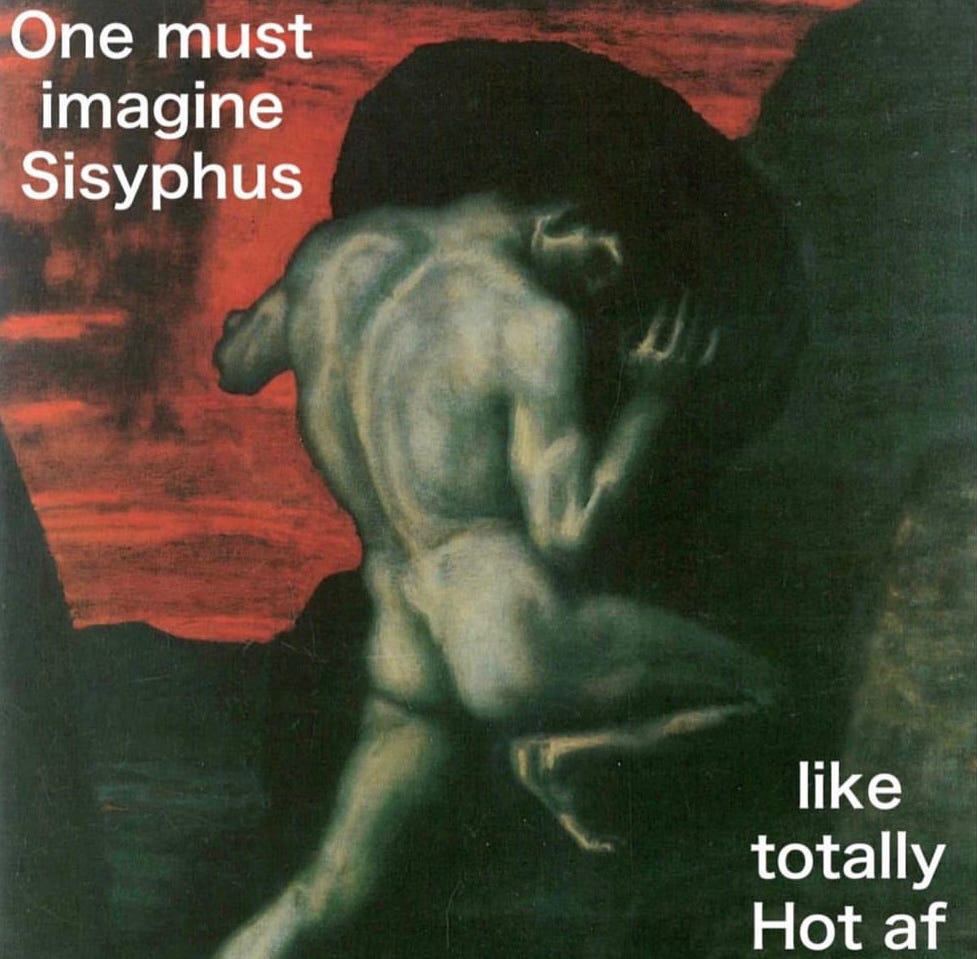
Michel Foucault, reflecting in 1982 on BDSM practice, identified what negotiated power exchange generates as “the real creation of new possibilities of pleasure, which people had no idea about previously.”20 The constraint of the scene, the rules established in advance, and the structure within which surrender takes place, produce experiences inaccessible outside that structure. Practitioners describe the space a scene creates as “a bubble, or a magic circle, denoting a space distinct from the everyday, an alternative as-if reality within which different qualities of experience, relationship, self and other can be explored.”21 The boundary generates a charge, and submission to the rule generates a particular kind of power and pleasure.
Magical practice is also an art, and its formal constraints generate the same eros. The magic circle concentrates the encounter, heightens attention and sensation within the boundary, and mediates contact with overwhelming or dangerous forces. It facilitates the ecstasies of spirit flight by protecting the physical body of the witch. The spirit pact takes this even further. Its conditions are often initiatic: rendering a person something more than human; disassembling them completely to produce someone new.
The classical memory palace demonstrates constraint operating on the level of the imaginal. Frances Yates's The Art of Memory describes the loci as a fixed architectural structure, real or imagined, within which vivid images are placed.22 The more rigid the spatial constraint, the more the system can hold, the more creative associations it generates. Giordano Bruno transformed the method into combinatorial mnemonic wheels: concentric rotating rings of mythological figures and symbols that generated vast associative possibilities within a fixed structural framework.
The astrological election constrains time rather than space. The practitioner submits to the celestial bodies, waiting for a precise configuration and yielding to that window absolutely. The window may be twenty minutes wide, or it may not come again for years. That waiting is itself a form of longing. When the moment finally opens, its brevity creates its own intensity: everything sharpened, charged, and urgent, the work happening under pressure of the closing window.
Lacan observed something related in his reading of Paul’s letter to the Romans: the commandment “thou shalt not covet” generates desire.23 Before the prohibition, there is no particular object of longing. The Law names what cannot be had, and by naming it, makes it the thing that is desired. This is the mechanism of jouissance, the specific quality of pleasure that constraint generates: overwhelming, dissolving, the little death Barthes names when he borrows the French word for orgasm. As Lacan puts it, “transgression in the direction of jouissance takes place only if it is supported by the forms of the Law.” It is in the friction of struggle against a limit that we touch the sublime.

other ways to connect:
my jewelry • jewelry instagram • my personal website • personal instagram

Daniel Levin Becker, Many Subtle Channels: In Praise of Potential Literature (Harvard UP, 2012)
Calvino, “Cybernetics and Ghosts,” in The Uses of Literature: Essays, trans. Patrick Creagh (San Diego: Harcourt Brace Jovanovich, 1986)
Michel Foucault, “Sex, Power, and the Politics of Identity,” The Advocate, 1984; collected in Ethics, Subjectivity and Truth, ed. Paul Rabinow (The New Press, 1997).
Alison Robertson, “He can cane me to orgasm, or he can cane me to hysterical tears: The Co-Construction of BDSM Experience,” Journal for the Study of Religious Experience, Vol. 7, No. 1 (2021), 19-34.
Frances Yates, *The Art of Memory* (University of Chicago Press, 1966).
Jacques Lacan, The Seminar of Jacques Lacan, Book VII: The Ethics of Psychoanalysis, 1959-1960, trans. Dennis Porter (New York: W.W. Norton, 1992)
This is very inspiring
I enjoyed this piece so much. Your whole thread of thought was a delight to follow. From OULIPO, which to me is another example of the playfulness of the French intellect (which I won't lie, makes me feel sort of proud of my culture lol), to your incursion into media theory with oulipian Twitter, to then end with the erotic dynamics that underlie art, magic, and creativity. YAY!